Verity Magic
Contents
What is the Nature of Magic in Aeratal?
To understand magic in Aeratal, one must first understand that magic is not natural to Aeratal. It is not inherent to the land, nor to the people, nor to reality itself. For most of Aeratal’s history, magic did not exist. The world was mundane, stable, and governed by ordinary physical laws. The fine folk lived agrarian lives without spells, without enchantments, without apparitions, and without any metaphysical forces shaping their existence.
Magic only emerged with the arrival of the Verity — the cyclonic tear in the fabric of the Universe — and the presence of the wider Cascade front in the heavens. When the Verity appeared, reality softened. The boundaries between thought and matter, between emotion and energy, between will and consequence began to blur. The Skein, the underlying lattice of reality, became pliable. And magic seeped into the world.
By the time the story begins, magic has been present for several hundred years. It is not new, but it is also not ancient. It is woven into the world, but not inherent to it. It is understood, but not mastered. It is feared, respected, and relied upon — but always with the knowledge that it is a foreign force, a cosmic intrusion, a consequence of the Verity’s presence in the sky.
Magic in Aeratal is universal. It permeates the entire kingdom, weaving through and binding all things, physical and animate. The Skein is a field of existence — a metaphysical current that saturates reality. It flows through stone and soil, through rivers and forests, through people and creatures, through the very air itself. And it is accessible to all.
But accessibility is not the same as capability.
The vast majority of people in Aeratal cannot, by themselves, cast magic in any deliberate or meaningful way. They cannot conjure fire, bend light, or manipulate energy. But their existence alone — their will, their belief, their emotional resonance — subtly manipulates the Skein. Every person contributes tiny distortions, minute influences, faint ripples in reality. Individually, these influences are negligible. But collectively, they can become powerful.
Soft vs Hard Magics
Soft magic is the magic of rituals, blessings, charms, and communal rites. It is subtle, gentle, and deeply cultural. A village might perform a harvest ritual that blesses the soil. A hermit might lead a protective rite that keeps apparitions at bay. A community might gather to impart a boon over their land, each person contributing a fraction of the total power needed to anchor the magic. The ritual works not because any one person is powerful, but because dozens or hundreds of people, acting with shared purpose, collectively manipulate the Skein.
Soft magic is universal because people are universal. Where there are people, there is will. Where there is will, there is magic.
But at the other end of the spectrum lie the hard magics — the magics of individuals. Hard magic is the deliberate, forceful manipulation of the Skein by a single person. It is precise, technical, and often dramatic. Whether it is by learned wizards or adept mages, hard magic is the magic of singular capability — the ability of one person to do alone what entire communities can only achieve together. It is the sharp, immediate, reality‑shaping edge of Aeratal’s metaphysics.
Hard magic is the engine of Aeratal’s magical advancement. It is the source of its greatest wonders — and the root of many of its deepest fears. It is the magic that empowers weapons, shields armies, binds apparitions, and stabilises fractured regions. It is also the magic that can destabilise reality if wielded without conviction or clarity of will.
Magics Contingent on Belief and Will
Because whether soft or hard, all magic in Aeratal shares one defining trait: its effectiveness is contingent on belief and will.
Magic is shaped by consciousness. It responds to conviction. It is strengthened by certainty. The rituals of a village work because generations have believed in them. The spells of a wizard work because thousands have studied and reinforced them. The enchantments of a guild work because the collective confidence of its members anchors the magic in place. Magic is not just metaphysical — it is psychological.
This dependence on belief means magic can be tenuous. If confidence wanes, magic weakens. If doubt creeps in, magic falters. If fear overwhelms the caster, magic can break entirely. And when magic breaks, it does not simply fail — it reverberates. It snaps back. It lashes out. It can destabilise the Skein, rupture reality, or even create apparitions born from the caster’s own fear.
This is why magic in Aeratal is both wondrous and dangerous. It is accessible to all, yet mastered by few. It is powerful, yet fragile. It is universal, yet deeply personal. It is shaped by the world, yet shaped by the people within it.
Magic is the heartbeat of Aeratal. It is the force that binds the world together, the tool that shapes its wonders, and the danger that threatens its stability. It is the reason factions rise, the reason heroes emerge, and the reason the world feels both mythic and precarious. And understanding the nature of magic is the first step in understanding Aeratal itself.
The Maelstrom of Verity Magics
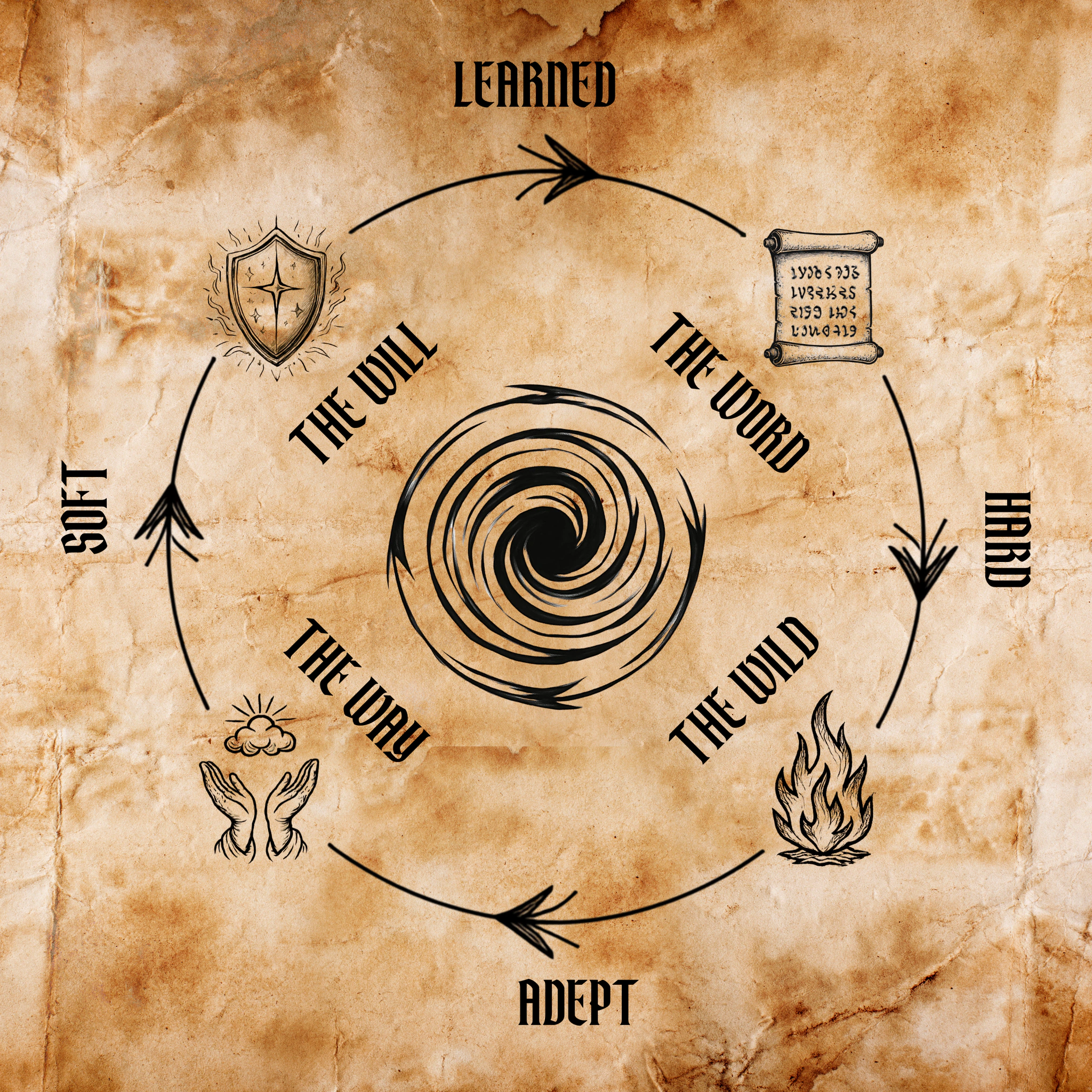
The Maelstrom is the great map of magic in Aeratal. It is not a spell, nor a ritual, nor a doctrine, but a way of seeing the forces that swirl through the world. When magic first seeped into Aeratal after the arrival of the Verity, it arrived without instruction, without pattern, without any sense of order. It was a raw, cosmic intrusion — a softening of reality that allowed will, belief, instinct, and knowledge to shape the Skein in ways no one had ever imagined. For decades, the people of Aeratal struggled to understand it. Some villages developed rituals that seemed to work. Some individuals discovered they could bend the world through sheer force of will. Others found that careful study produced reliable results. And still others found magic surging through them without warning.
It was chaos — beautiful, terrifying chaos.
Over generations, scholars, mystics, wanderers, Skeinweavers, and even the earliest guilds began to observe patterns. They noticed that some magics were gentle and communal, while others were sharp and forceful. Some magics emerged from instinct, while others required years of study. Slowly, these observers realised that magic tended to fall along two great axes: soft to hard, and adept to learned.
Soft magics are gentle, cultural, and communal — magics that flow through groups, traditions, and objects. Hard magics are forceful, structured, and immediate — magics that bend reality with precision or raw power. Adept magics arise from instinct and natural resonance, from the innate ability to feel the Skein. Learned magics come from study, discipline, and the accumulated knowledge of generations.
The Maelstrom is not a hierarchy, nor a ranking of power. It is simply a way of understanding how magic expresses itself through people, and how those expressions shape the world in return. Every caster, every ritual, every spell, every enchantment sits somewhere within this swirling map — and most drift between categories over their lifetime. The Maelstrom is alive, shifting, and ever‑turning, just like the Skein itself.
Currents of Verity Magic
Where these axes meet, four great currents of magic emerge — four ways in which people shape the Skein, and four ways in which the Skein shapes them. These currents are known as the Magics of the Way, the Magics of the Will, the Magics of the Word, and the Magics of the Wild. Together, they form a cycle: Way to Will, Will to Word, Word to Wild, and Wild back to Way. It is a turning of tradition, craft, knowledge, and instinct — a cycle that has defined Aeratal’s magical culture for centuries.
We begin with the Magics of the Way. These are the soft adept magics — the ritual traditions, the communal blessings, the rites that bind villages together. They emerge not from study or raw individual power, but from shared belief and the subtle adeptness that lies dormant in all people. A village gathering at dusk to steady the Skein around their homes, a hermit leading a protective rite, a Warden of the Way guiding a community through a blessing — these are the Magics of the Way. They are gentle, cultural, and deeply rooted in memory. They were the first magics to appear in Aeratal, arising naturally as people sought to understand and stabilise the strange new forces brought by the Verity.
Magics of the Way are woven into the rhythms of daily life. They appear in festivals, funerals, harvest rites, and the quiet ceremonies that mark the turning of the seasons. They are the magics of shared purpose — the kind that grows stronger when a community gathers, when voices join, when hearts align. Even the smallest village, even the humblest hamlet, carries some tradition of the Way. These magics are not dramatic, but they are enduring. They are the foundation upon which all other magics rest.
From the Way, the cycle turns to the Magics of the Will. These are the soft learned magics — the enchantments, the artefacts, the runes carved into blades and armour. Unlike the communal rites of the Way, Magics of the Will require knowledge and technique, but they remain soft because the magic is anchored into objects rather than wielded directly as force. A Rune‑Knight of the Will inscribing a blade, a guild enchanter crafting a lantern that wards off fear, a cleric blessing a shield to steady courage — these are the Magics of the Will.
Magics of the Will are the backbone of Aeratal’s magical craftsmanship. Every enchanted lantern in a village square, every rune‑etched wardstone at a crossroads, every blessed charm worn by a traveller — all of these are expressions of the Will. These magics make the world safer, more stable, more predictable. They allow magic to be carried, traded, gifted, and inherited. They turn magic into tools, into heirlooms, into symbols of protection and hope.
From craft, the cycle turns to knowledge — the Magics of the Word. These are the hard learned magics, the codified spells, the incantations, the scrolls, the structured manipulations of the Skein that require discipline and precision. Wizards of the Word — and many other learned casters we’ll explore in the next episode — spend years mastering these magics. When a wizard speaks an incantation, they draw on centuries of accumulated belief, reinforced by thousands who have studied the same spells.
Magics of the Word are the magics of scholarship, of structure, of knowledge refined into power. Spellbooks, academies, guild halls, and libraries all serve as repositories of the Word, preserving the techniques that allow casters to bend the Skein with clarity and control. These magics shape storms, conjure illusions, bind apparitions, and alter reality with deliberate force. They are the magics of precision — the closest Aeratal comes to a science of magic.
And from knowledge, the cycle turns to instinct — the Magics of the Wild. These are the hard adept magics, the raw and immediate manipulations of the Skein that surge from natural talent and emotional resonance. Mages of the Wild do not learn magic; they feel it. Their connection to the Skein is intuitive, allowing them to conjure fire without words, bend light without theory, and shape energy without ritual.
Magics of the Wild are powerful, unpredictable, and deeply personal. They are the untamed forces that surged into Aeratal when the Verity softened reality, the magics of passion, impulse, and raw will. Wild magic is often feared, sometimes revered, and always respected — for it is the closest Aeratal comes to witnessing the raw metaphysical turbulence of the Cascade itself. These magics can be beautiful or terrifying, depending entirely on the heart of the caster.
And so the cycle turns: instinct flows back into tradition. The Magics of the Wild inspire new rites, new stories, new communal practices — feeding once more into the Magics of the Way. A Wild mage’s sudden act of courage might become a village’s annual blessing. A raw surge of magic might be ritualised into a seasonal festival. In this way, the cycle continues, generation after generation.